
IPTV Bolaget: Vetting the Company Behind IPTV in Sweden
What IPTV bolaget means, what Swedish law actually says in autumn 2026, and how to check the company behind a service before you pay for it.
Choosing internet TV in Sweden? 98% can get gigabit broadband but only 61% subscribe. How to check your connection first, then pick the right service.
Searching for the best internet TV usually means comparing services. In practice the answer often turns on something else entirely: the connection you already have, and whether it has ever been switched on.
This guide explains what internet TV covers, why almost every Swedish household can get it while far fewer actually have it, how to judge which type suits you, and what to check before paying. It is written for people living in Sweden, including those who arrived recently. Information checked 11 October 2026.
Internet TV is television delivered over broadband instead of an aerial, cable or satellite dish. The term covers play services, international streamers, operators' own TV apps and standalone IPTV services with their own credentials — four things that differ in schedule, catalogue and terms, and that get muddled together:
Technically it is the same principle throughout: content sent as data to your connection alone. What differs is the content, the terms and who you have a contract with. How distribution works in Sweden as a whole is covered in our guide to digital TV in Sweden.
Here is the most overlooked statistic of the year, and it comes from the regulator. According to the Post and Telecom Authority's mapping, about 98 percent of households could connect to fibre, 86 percent had it in the building, and 61 percent actually subscribed. The gap is the point.
According to the Swedish Post and Telecom Authority's mapping, about 98 percent of households and businesses — just over 6.1 million — had fibre or the option to connect to fixed broadband as of 1 October 2025. In sparsely populated areas the figure was around 88 percent. But only about 86 percent have fixed broadband installed in the building, and just 61 percent are estimated to have taken out a subscription, according to PTS (in Swedish).
| Step | Share of households and businesses |
|---|---|
| Could connect to fast fixed broadband | about 98% |
| Have broadband installed in the building | about 86% |
| Have taken out a subscription | about 61% |
Read the table from the bottom up and the point is clear: for roughly a quarter of households the fibre is already in the building, unactivated. That is not a technical barrier — it is a decision nobody made.
The gap has two common explanations. Either the property was connected during a rollout without every household subscribing, or the household uses mobile broadband and never activated the fibre, often after moving in. Both are fixed with a phone call, and switching on what already exists usually costs less than people expect.
For newcomers this is worth pressing on, because nobody volunteers it. Ask your landlord or housing association directly: is the property connected to fibre, is there a socket in the flat, which service providers are connected, and what is the cheapest connection? Four questions, one call.
A word about the question itself. In Sweden the word "best" is governed by marknadsföringslagen, which requires such claims to be substantiated. That is why serious comparisons describe who something suits rather than crowning a winner — and why we do not claim our service is best.
Which internet TV is best for you comes down to five things:
The full method for weighting and scoring those criteria, including the cost-per-evening calculation, is in our guide to choosing a subscription. This guide covers the step before: which kind of internet TV fits, and whether the technology at home can carry it. If you want to know what a discount must be built on, see the rules behind a reduced price.
The family with three screens running. Simultaneous streams matter most, then children's content and stability. A cable to the most-used TV is almost always worth the trouble here.
The couple watching series and some sport. Content decides. The common trap is paying for sport through months when nothing is played; short periods beat discounts.
Someone living alone, or here temporarily. Flexibility wins: no long contract, nothing requiring new hardware, and ideally something that runs on the TV already in the flat.
Decide which profile resembles yours before comparing. Otherwise the offer with the best marketing wins rather than the one matching how you watch.
In practice the choice is between three routes: play services alone, the operator's own TV app, or a standalone IPTV service. They differ less in price than in flexibility — how easily you can change, pause or leave when your needs shift.
| Solution | Suits | Weakness |
|---|---|---|
| Play services only | series and film, rarely live | no schedule, sport usually missing |
| The operator's TV app | one bill and Swedish support | often a binding period, harder to change |
| A standalone IPTV service | a broad line-up on your own devices | you choose and vet the provider yourself |
Play services are the easiest to start and stop, and need no equipment beyond the TV. They lack a schedule, and sport is rarely included.
An operator app gives you one invoice and Swedish-language support, but ties you in hardest. It is the model where switching costs the most time.
A standalone service gives the broadest line-up on hardware you already own, in exchange for judging the provider yourself — which is why vetting matters more here than in the other two.
Most households combine them. What decides is how you watch: anyone who mainly watches individual programmes is well served by play services, anyone who wants to turn the TV on and land in something needs a schedule, and anyone following sport has the least flexibility of all.
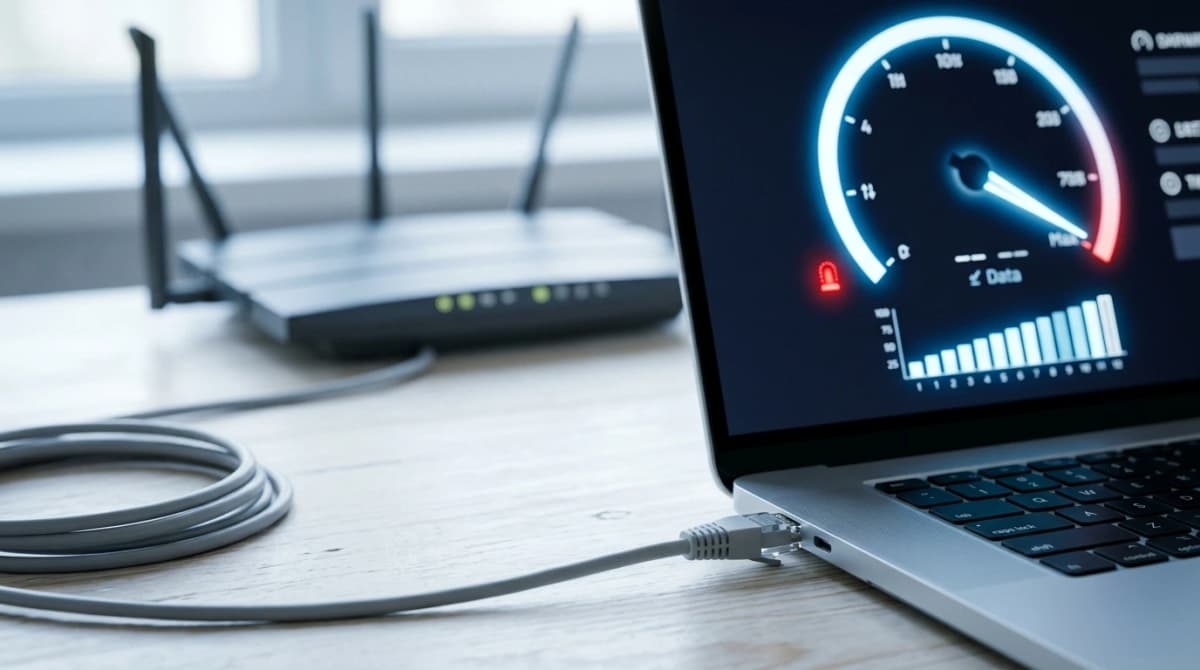
Before switching services, measure what you actually have, and it takes ten minutes. Test first with an Ethernet cable at the router, then over Wi-Fi where the TV sits, then repeat in the evening when the network is busiest. The order matters:
Reading it is simple. Above 25 Mbps at the TV in the evening is enough for 4K. A big drop between steps one and two means Wi-Fi is the bottleneck, not the subscription — and a cable solves more than a faster plan.
One thing often missed: check how old the router is. A router supplied seven years ago may lack 5 GHz support entirely, and then the speed arriving at the building matters less.
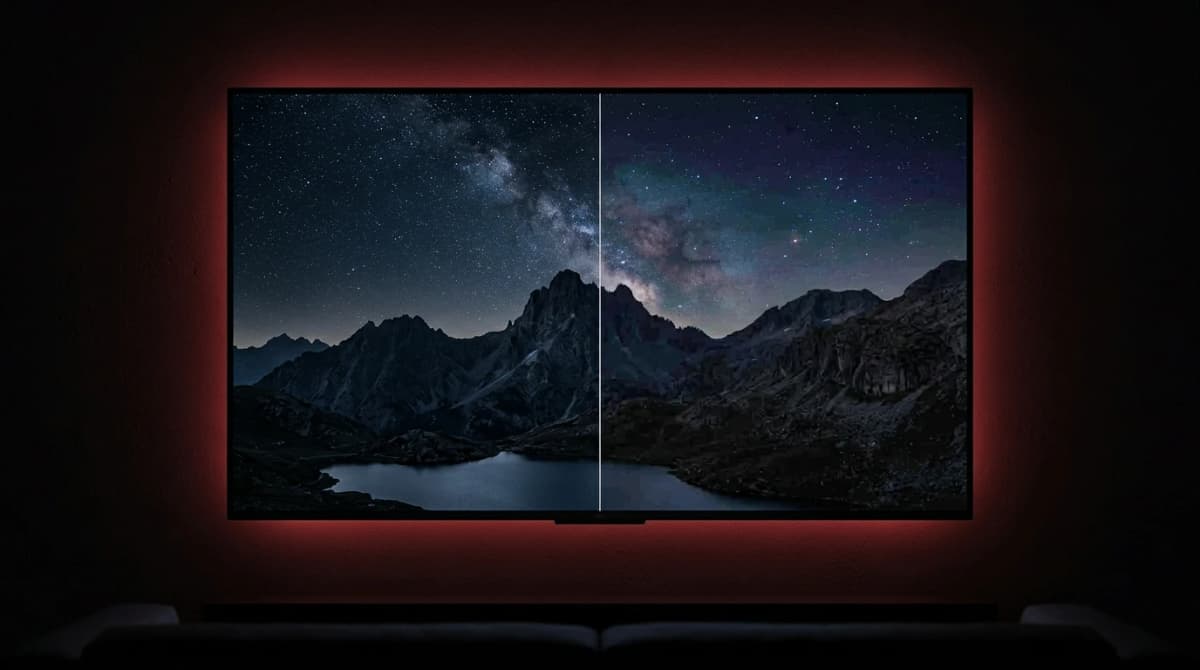
Resolution gets the attention, but it is one of three factors. Bitrate decides how much information each second carries, stability decides whether that quality holds when the connection wobbles, and the screen size together with your viewing distance decides what you can perceive at all.
Bitrate decides how much information each second carries. A 4K stream at a low bitrate can look worse than a well-compressed HD stream, especially in dark scenes and fast motion — sport, where the difference shows most.
Stability decides whether that quality holds. Most services lower quality automatically when the connection wobbles, and what you experience as "sometimes blurry" is usually that.
The screen and your distance decide what you can perceive at all. On a 55-inch TV from three metres, the difference between good HD and 4K is small for most eyes — worth knowing before paying extra for a tier you cannot see.
The conclusion for internet TV: a steady stream at the right level beats a stuttering one at a high level. That is why we recommend headroom rather than the highest possible number.
To compare concrete prices and campaign terms, the template is in our IPTV comparison guide.
Whichever kind of internet TV you land on, the same four checks apply: who stands behind the service, what applies to cancellation and refunds, how you pay, and what is actually promised about the line-up. They take a few minutes and save considerably more.
Keep the paperwork from the purchase — receipt, payment confirmation and the terms as they stood. If you need to complain later, that is the difference between an easy case and a hard one.
Three claims recur in almost every discussion of internet TV, and all three fail the same way: they measure what is easy to measure rather than what decides the experience. Speed, channel counts and breadth sound concrete but say little about an ordinary evening.
"I need the fastest broadband to stream." No. You need enough and steady. The difference between 250 and 1,000 Mbps rarely shows in TV watching, while the difference between Wi-Fi and cable shows immediately.
"More channels is better." A line-up of 18,000 and one of 4,000 rarely differ in what a household watches in a week. What counts is whether your channels are there.
"Internet TV replaces everything else." For most people it is a complement. Public service remains on the aerial, play services hold their own content, and sport often sits behind separate deals.
Two things are worth watching, because they shape what "best internet TV" means a year from now: the line-up keeps moving from linear channels into play services, and prices keep shifting as ad-supported tiers grow and services merge. Don't build your setup on everything standing still.
The line-up keeps moving. Linear channels are being wound down and their content lands in play services — most recently with Kunskapskanalen ending as a linear channel at the new year. More services to track, fewer channels to flick between.
Prices and packaging keep shifting. Ad-supported tiers have grown quickly and cost less than ad-free ones, while services merge and change names. A contract without a binding period is therefore worth more than a small discount, simply because you can act when something changes.
IPTV NORDIC is one of the solutions in the table above: a standalone internet TV service with login credentials that work in standard IPTV apps on smart TVs, Android TV, Fire TV Stick, Apple TV, phones, tablets and computers. We sell neither broadband nor hardware.
According to our service description it includes 18,000+ live channels, 40,000+ movies and 12,000+ series, 8K / 4K Ultra HD ready with FHD where available, a TV guide (EPG) and catch-up, activation in about a minute, round-the-clock support and a seven-day money-back guarantee. Plans cost €15 for one month, €35 for three, €45 for six and €65 for twelve months, with 2–5 simultaneous streams depending on the plan. See every feature, the supported devices, or start from the home page.
What we don't claim: that we are the best, that any specific named channel or sport is included, that we replace public service, or that we sell any way around geographic restrictions. Questions before buying are answered in the FAQ or through the contact page.
Start with the connection, not the service. 98 percent could get fast fixed broadband, 86 percent have it in the building, 61 percent subscribe. The fibre is often already there.
The best internet TV is the one matching how you watch. Content, simultaneous streams, connection, flexibility and support — in that order, not by price.
Speed is rarely the problem. 15 Mbps for HD and 25 for 4K is enough for any service worth paying for; your home network, not the contract, decides the rest.
Test before you pay, and redo the exercise whenever a contract ends, a price rises or the household starts watching differently. It takes a quarter of an hour, and that quarter decides whether you are paying for the right things next year.
To compare what a service costs with us, plans and terms are on the plans and prices page.
What IPTV bolaget means, what Swedish law actually says in autumn 2026, and how to check the company behind a service before you pay for it.
Best and cheapest IPTV are two different questions. How Sweden's 30-day price rule works, and the change that may remove it for subscriptions.
Free IPTV in Sweden: what you can genuinely watch free and legally, what the free IPTV lists cost instead of money, and where you stand as a viewer.