
IPTV Comparison in Sweden 2026: How to Compare Fairly
An IPTV comparison that holds up: campaign prices that doubled, a regulator order over misleading phone sales, and the template you fill in yourself.
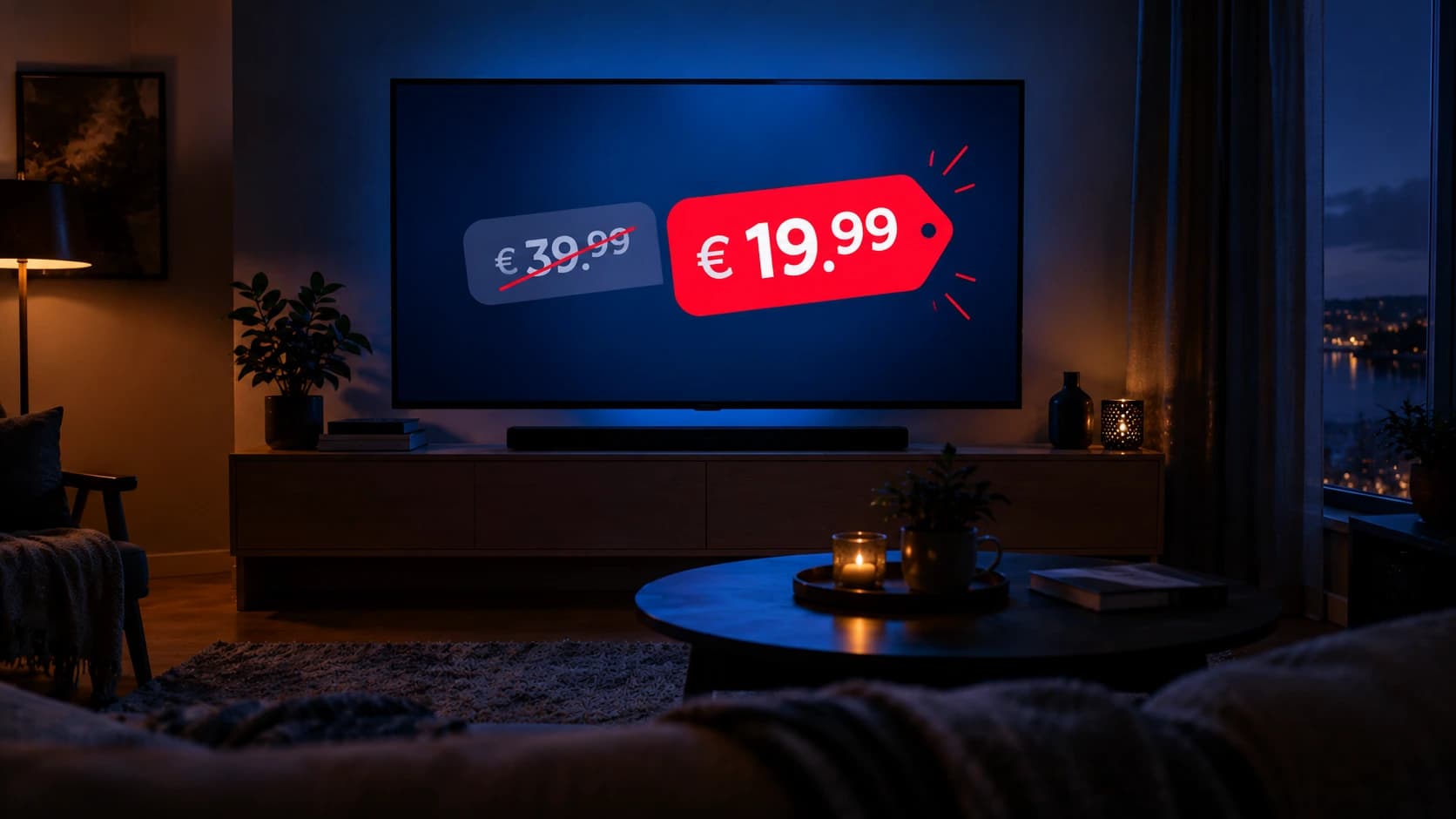
Best and cheapest IPTV are two different questions. How Sweden's 30-day price rule works, and the change that may remove it for subscriptions.
"Best and cheapest IPTV" is a search that contains two questions pulling in opposite directions. One can be calculated. The other can be reasoned about, but only once the first is settled.
This guide takes them in that order, and it is written for people living in Sweden who did not grow up with the Swedish consumer rules. First, what a price claim legally means here — what applies when a seller says a price has been cut, how a discount may be calculated, and why a struck-through price proves nothing on its own. Then how to work out what is cheapest for your household, and what is left to weigh once the money is settled. Information checked 26 October 2026.
A price is one number, and numbers compare. Quality is several properties that do not add up: stability on a Friday evening, how fast somebody answers when the picture stutters, how many people can watch at once, whether the content you care about is actually there.
That does not make price unimportant. It means "cheapest" is a question you can answer with a calculator, while "best" is a question whose answer depends on who is asking. A household of five with a hockey winter ahead of it does not have the same best option as one person watching the news and a series a week, even on an identical budget.
So the practical order is: calculate first, judge second. The reverse — choosing on instinct, then hunting for a price that justifies the choice — is how most bad subscriptions get bought.
There is a legal point buried in the wording, too. Swedish marketing law treats bäst and billigast — best and cheapest — as claims that must be substantiable, not as general praise. A seller who says a service is the cheapest is making a concrete assertion about the entire market, and that assertion has to be provable. It is one reason serious price information tends to come as dated figures rather than superlatives.
This is a concrete rule worth knowing, and it reaches far beyond television. Under section 7 a of prisinformationslagen, a previous price must be stated when something is marketed as reduced, and that price must be the lowest one used in the preceding 30 days.
Under section 7 a of prisinformationslagen, the Price Information Act, a previous price must be stated when a product is offered with an indication that the price has been reduced. The provision reads: "Om en produkt tillhandahålls med angivande av att priset har sänkts ska även det tidigare priset anges." And the previous price is not any old figure. Konsumentverket, the Swedish Consumer Agency, puts it this way (in Swedish): the earlier price must be the lowest price used for the product in the 30 days before the reduction.
Three things follow:
Alongside this sits the Marketing Act (marknadsföringslagen): section 10 prohibits misleading representations, and section 17 governs how words such as sale, campaign and discount may be used.
The rule only becomes clear with figures. Konsumentverket published two when it ordered ten companies to correct their marketing in May 2025, and both show the same mechanism: the discount was calculated from a different and higher price than the lowest of the period, so the offer was not really an offer at all.
The winter jacket. Advertised at 22% off. The percentage was calculated from a price higher than the lowest of the preceding 30 days. Measured against the correct comparison figure the jacket was not discounted at all — it was 299 kronor more expensive than it had been during the period.
The face cream. Sold at 724 kronor against a stated former price of 965. The correct comparison price was 675 kronor, so the offer price sat above the lowest price of the period, according to Konsumentverket's press release of 19 May 2025 (in Swedish).
Neither figure was invented. Both were real prices that had existed at some point. The error was in which price was chosen as the starting point — and that is precisely the detail a reader cannot see.

Enforcement here is not theoretical, and it reaches large, familiar businesses. In May 2025 ten well-known companies were ordered with a combined 22 million kronor in penalties, and that November seven more with a potential 8.6 million. Several had already promised once to correct their price marketing.
In May 2025 the Consumer Ombudsman (Konsumentombudsmannen, KO) issued orders against ten well-known companies — among them Blomsterlandet, Bygghemma, Nakd, Nordic Nest, Power, Soffadirekt, Stadium, Webhallen, XXL and Åhlens — carrying a combined penalty of 22 million kronor. All had previously promised to correct their price marketing and were found wanting again.
That November brought the next round. On 17 November 2025, seven companies — H&M, Desenio, Bokus, Home Furnishing Nordic, Inet, Kjell & Co and Tretti — were ordered with potential penalties of 8.6 million kronor, according to Konsumentverket (in Swedish). A vite is forward-looking: it falls due only if the breach is repeated.
The point is not which companies were caught. It is that incorrect discount claims are common enough that the regulator has to return to the same firms — and that an industry without that supervision is unlikely to be better behaved.
Two things are in motion right now, and both matter before you rely on the rule: one company has won against the Consumer Ombudsman in court, and a bill proposes narrowing the provision to goods only — which would exclude services such as a television subscription.
One company won. The Patent and Market Court set aside the Consumer Ombudsman's order against Inet AB, finding that the company had not failed to provide price information under section 7 a and had not breached the prohibition on misleading marketing, according to Konsumentverket's summary published on 20 March 2026 (in Swedish). The rules are not self-evident even to the authority enforcing them.
And the provision may shrink. Today section 7 a is tied to the word produkt, which the preparatory works define as "varor, tjänster eller andra nyttigheter" — goods, services or other benefits. A service subscription sits inside that wording. A bill referred to the Council on Legislation on 15 October 2026 (Fi2026/00996) would swap the word for vara, so the provision would read: "Om en vara tillhandahålls med angivande av att priset har sänkts ska även det tidigare priset anges." The stated reason is to align Swedish law with the EU price indication directive, which concerns goods. Entry into force is proposed for 1 March 2027; the earlier memorandum said 1 February.
If it passes, the 30-day rule stops applying to services — and a television subscription is a service. The Marketing Act's ban on misleading price information remains, but the specific, measurable rule about the comparison price does not. This is a proposal as this is written, not law in force, and the status is worth checking before you invoke the rule for a subscription.
With the rules in place, the checklist is short. Five questions cover it: what the price is compared against, how long the offer lasts, whether the discount is calculated from the right figure, what is added on top of the headline number, and what happens at renewal.
If you want the method for putting concrete offers side by side, it is in our guide to comparing IPTV, along with the traps in time-limited prices.
This is the arithmetic, and it takes a few minutes. Decide how long you expect to keep the service, count promotional and ordinary months separately, add any one-off fees, divide by the number of months — and then divide again by the number of people who actually watch.
Step six is what most often moves the answer. A subscription allowing more simultaneous streams can cost more per month and still be cheaper per viewer, and per viewer is what the household actually pays.
| What you include | Why it changes the answer |
|---|---|
| Promotional months and ordinary price | A low entry price can carry the highest total |
| Fixed term | Sets how many months you must count, not how many you want |
| One-off fees | A box and installation rarely appear in the monthly figure |
| Simultaneous streams | Decides cost per viewer, not per subscription |
| Overlap with streaming services | Paid content you already have is a hidden double cost |
That last row deserves its own check. The most common way to cut a television bill is not finding a cheaper subscription but cancelling something you already pay for and do not watch.
Our prices are dated and you can do arithmetic on them: 15 euros for one month, 35 for three, 45 for six and 65 for twelve, which is about 5.40 euros a month on the annual plan. No fixed term, no automatic renewal.
| Plan | Price | Per month | Simultaneous streams |
|---|---|---|---|
| 1 month | €15 | €15 | 2 |
| 3 months | €35 | about €11.70 | 3 |
| 6 months | €45 | about €7.50 | 4 |
| 12 months | €65 | about €5.40 | 5 |
No fixed term, no automatic renewal and a seven-day money-back guarantee on every plan. The details are on the plans and prices page.
We do not claim this is the lowest price on the market. It is a dated figure you can do arithmetic on, which is a different thing from a superlative — and under Swedish marketing law a claim like cheapest has to be substantiated by whoever makes it.

Now the other half of the search. When two options cost roughly the same per viewer per month, the decision turns on things no price list shows: stability when the network is busy, support that actually replies, content in your own categories, the terms during an outage, and what your own connection can carry:
None of these can be read off a price list, which is exactly why the two questions have to be kept apart. The price is on the page before you buy. The rest only shows up afterwards — which is why a short trial and a short first period are cheaper than they look: they cap what a wrong choice costs.
The last two points have their own guides: the criteria and how to weight them are in our review of the best IPTV subscription, and the question of which kind of internet TV your connection can carry is in the best internet TV. We recommend at least 15 Mbps for HD and 25 Mbps for 4K; what is included is listed under features. How the signal reaches you at all is set out in the four routes television takes into a home.
Four errors recur again and again among people chasing the lowest price: comparing entry prices instead of totals, treating a struck-through price as proof, forgetting how many people actually watch, and chasing zero rather than costing out a sensible option per viewer.
IPTV NORDIC is an IPTV service with login credentials that work in standard IPTV apps on smart TVs, Android TV, Fire TV Stick, Apple TV, phones, tablets and computers. Sales and support run through WhatsApp, and what follows sets out both what is included and what we explicitly do not claim.
According to our service description it includes 18,000+ live channels, 40,000+ movies and 12,000+ series, 8K / 4K Ultra HD ready with FHD where available, a TV guide (EPG) and catch-up, activation in about a minute, round-the-clock support and a seven-day money-back guarantee. More answers are in our frequently asked questions, and anything else can go through contact.
What we don't claim: that we are the cheapest or the best, that any named channel or sport is included, that we sell any way around geographic restrictions, or that the line-up will stay the same forever. The seven-day guarantee also applies in addition to your statutory rights, not instead of them — how those work on a distance purchase is set out in buying IPTV in Sweden.
Four things to take away when you are weighing the best and cheapest IPTV.
Cheapest is a calculation; best is a judgement. Do the calculation first and the judgement gets easier.
A reduced price carries a legal requirement. The comparison figure must be the lowest of the previous 30 days, the discount must be calculated from it, and it must be shown nearby. Konsumentverket's reviews show how often that needs enforcing.
The rule may shrink on 1 March 2027. The bill of 15 October 2026 would limit section 7 a to goods, leaving service subscriptions outside it. Check where that stands before relying on it.
Calculate per viewer per month across the whole period. It is the only figure that compares between two offers.
If you want to see what that costs with us, every plan, term and price is listed under our subscriptions.
An IPTV comparison that holds up: campaign prices that doubled, a regulator order over misleading phone sales, and the template you fill in yourself.

Looking for the best IPTV subscription in Sweden? Growth has stalled, four million subscriptions were cancelled — here is how to compare properly.

IPTV Nordic 2026: illegal IPTV is down 27% in Sweden. What it means for expats: the public service fee, SINK, TV prices and a safe setup.