
Best and Cheapest IPTV in Sweden 2026: What Prices Mean
Best and cheapest IPTV are two different questions. How Sweden's 30-day price rule works, and the change that may remove it for subscriptions.
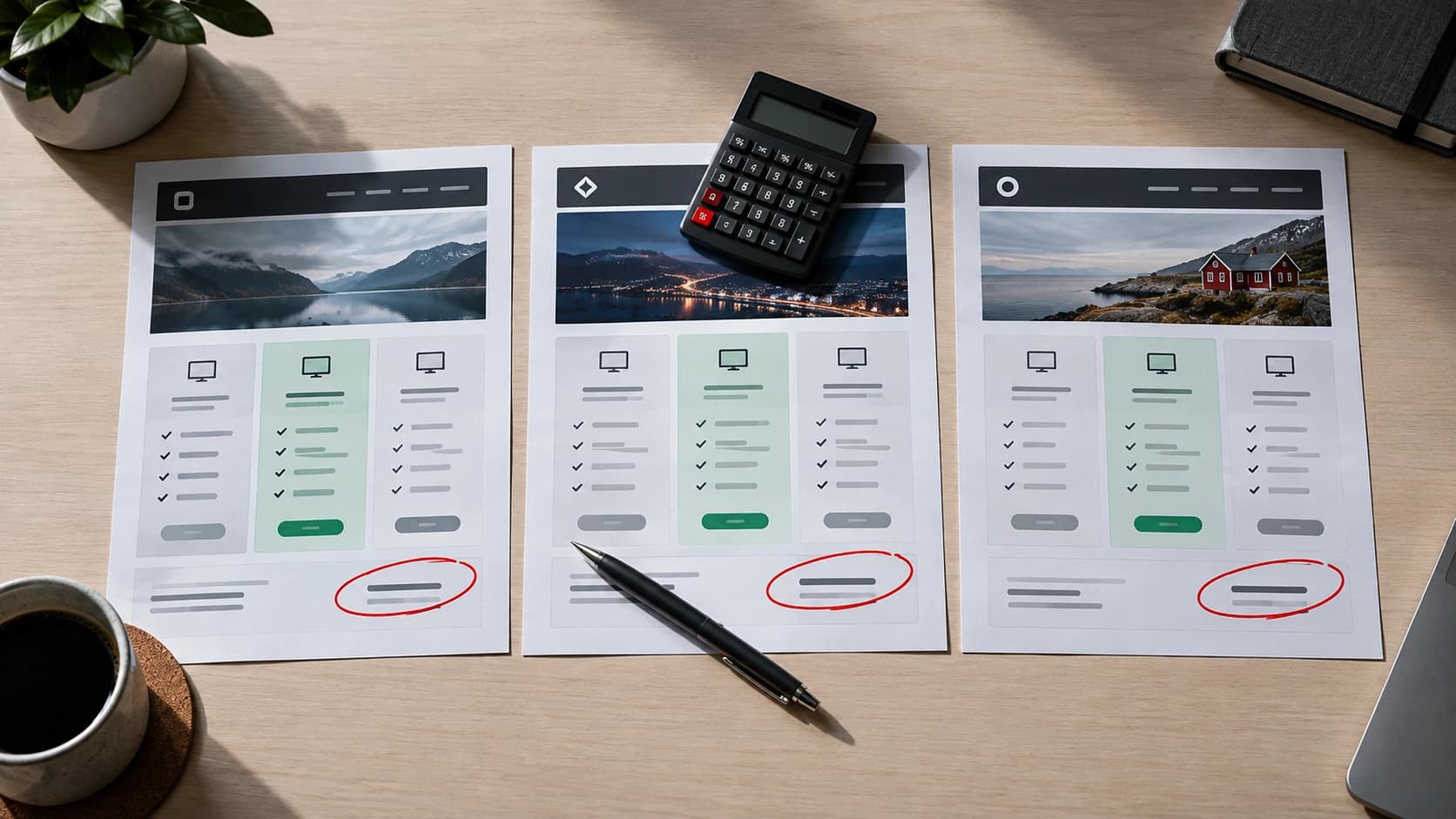
An IPTV comparison that holds up: campaign prices that doubled, a regulator order over misleading phone sales, and the template you fill in yourself.
An IPTV comparison looks simple: line the monthly prices up and pick the lowest. The trouble is that the headline number is rarely what you end up paying, and in autumn 2026 there are two concrete reasons for that.
The first is that Swedish operators have been cutting discounts rather than raising list prices. The second is that the sales channel itself can mislead — the consumer regulator issued an order against one provider this month. This guide shows what a comparison should contain and gives you the template to fill in. Information checked 15 October 2026.
Six facts decide what a subscription is worth, and price is only one of them: the total cost across the whole period, the number of simultaneous streams, the binding and notice periods, what the line-up includes, which devices are supported, and how support answers when something stops working.
The method for weighting these against each other is in our guide to choosing a subscription. This guide is about the numbers themselves and the traps inside them. What a reduced price must legally satisfy is covered separately in what a price claim means.
Order matters. Start from what the household needs rather than from what is cheapest, or you will compare away requirements you actually have. A package with one stream can be perfect for one person and useless for a family, and that difference never shows in the price.
This is the most useful finding for anyone comparing Swedish TV prices this year. In a review of 27 comparable TV packages, 15 had a higher campaign price between February and June 2026 while the list prices barely moved. Comparing campaign prices means comparing a moving number.
A review of 27 comparable TV packages at Telia, Tele2, Telenor, Boxer, Allente and Sappa checked prices on 24 February and 8 June 2026. The result: 15 packages had a higher campaign price, one had become cheaper and 11 were unchanged. List prices largely stayed where they were, as Dagens PS reported on 9 June 2026 (in Swedish).
| Package | Campaign price, February | Campaign price, June | Change |
|---|---|---|---|
| Allente Stream Basic | SEK 99/month | SEK 199/month | +101% |
| Boxer TV Bas | same increase | same increase | +101% |
| Tele2 TV Bas | same increase | same increase | +101% |
| Telia TV Mini | SEK 199/month | SEK 149/month | reduced |
These prices applied on 8 June 2026 according to the review and may have changed since. Always confirm the current price with the provider before comparing.
The point is not which operator raised the most. The point is which number you are comparing. A campaign price is temporary and has an end date; when it expires the list price takes over. Two packages that look equivalent during a campaign can differ by hundreds of kronor a month afterwards.
In practice: always write down both numbers, and calculate across the whole period you expect to keep the service.

The second trap sits in how offers are presented, and it catches newcomers hardest — cold-call selling of TV and broadband is common in Sweden. On 14 October 2026 the Consumer Agency ordered Allente to stop misleading telephone sales. A phone call is not a comparison.
On 14 October 2026 the Swedish Consumer Agency published an order against Allente for misleading telephone sales, listed in its own news feed (in Swedish). Sellers had given the impression they were calling from the consumer's existing provider, and customers were promised cheaper subscriptions than they received. The order requires the company to state its name clearly and to say that the purpose of the call is to sell its subscriptions.
Three things follow for your comparison:
The same principle applies whoever calls, including us: no serious seller demands an answer during the call.
Ask them in order and note the answers. Hesitation on any of them is itself an answer.
The fifth usually separates a genuine offer from a pressure tactic.
Search for an IPTV comparison and you meet dozens of ranking pages. Most earn from clicks or commission, which does not make them worthless — but it explains why the same handful of services top nearly every list. Four checks decide whether one is worth reading: the date, the method, the funding, and whether the prices verify at source.
Four quick checks decide whether a list is worth reading:
What no list can give you is how a service behaves on your network, on your TV, on a Friday evening. That part you test yourself, which is why a trial is worth more than a review.
One last thing: lists almost always compare campaign prices, because those look best. That is exactly the number that moved most during 2026.

The method takes five minutes and reveals more than any ranking: write down the campaign price and its length, the list price that follows, pick a twelve-month horizon, multiply and add. Then divide the total by the number of months for a comparable monthly figure.
Using the numbers above: a package at 99 kronor for three months and 199 after lands at (99 × 3) + (199 × 9) = 2,088 kronor a year, or 174 a month — not 99.
Compare that with a flat 150 kronor and you get 1,800 kronor, cheaper across the year despite the higher headline.
The same calculation on three common structures makes the difference concrete. These are examples, not offers.
| Structure | Months 1–3 | Months 4–12 | 12-month total | Average per month |
|---|---|---|---|---|
| Campaign that doubles | SEK 99 | SEK 199 | SEK 2,088 | SEK 174 |
| Flat price, no campaign | SEK 150 | SEK 150 | SEK 1,800 | SEK 150 |
| Paid annually up front | — | — | SEK 1,560 | SEK 130 |
Three lessons. The lowest headline produced the highest annual cost. A flat price beat the campaign. And paying annually was cheapest per month but committed the most money to a service you may not yet know — which is the argument for testing first and committing second.
One row per option. The columns are what actually separates services: campaign price and length, list price, binding period, number of streams, what is included, and the twelve-month total. Fill every field before comparing, or you end up setting incomplete rows against each other.
| Field | What you write |
|---|---|
| Campaign price and length | e.g. SEK 99 for 3 months |
| List price | the price after the campaign |
| 12-month total | the calculation above |
| Binding period | none, 12 or 24 months |
| Notice period | how long, and how you cancel |
| Simultaneous streams | screens at the same time |
| Devices | does it run on your TV? (see supported devices) |
| Support | channel and response time |
| Right of withdrawal | what the terms say |
Three rows is enough. If a box is hard to fill for some option, that is itself an answer — information you cannot find before buying rarely gets easier to obtain afterwards.
Fill it in with offers actually in front of you, not list prices found elsewhere. The gap between a published price and what you are offered can be substantial, especially by phone or near the end of a campaign.
The law sets the limits. According to Konsumentverket (in Swedish), a consumer contract may have a binding period of at most 24 months, and for contracts from 1 May 2014 the notice period may be at most one month. Within those limits the terms vary widely, and that is where a wrong choice turns expensive.
Two things deserve a specific check, because together they decide what a wrong choice costs you:
In a market where campaigns change every few months, a short contract is worth more than a discount. The whole purchase process is in buying IPTV safely.
Sport is almost always the most expensive line on a TV bill, and the hardest to compare. Two rules make it manageable: count per season rather than per month, and check what happens between seasons — can the subscription be paused, or does it simply roll on?
Count per season, not per month. A league runs a certain number of months. What matters is what you pay during them, plus any months you pay while nothing is played.
Check what happens between seasons. Can the subscription be paused, or does it roll on? Solutions differ most here, and price comparisons rarely say.
One note on line-ups: rights move between services, sometimes mid-contract. Don't build a long commitment on a particular sport staying where it is today. We never promise a named sport is included, and you should be sceptical of anyone who does.
Four things separate services without appearing in any price table: who you are contracting with, what your connection can actually carry, how support answers in practice, and what is genuinely included rather than merely counted. All four surface only when something goes wrong.
Who you are contracting with. Terms, contact routes and how the company behaves when something fails. The checklist is in the company behind your IPTV.
What your connection can carry. A cheap service on a weak home network is expensive in irritation. The test is in our guide to internet TV.
How support actually answers. Test before buying by asking a question and timing the reply.
What is genuinely included. Channel counts say less than whether your channels are there — and marketing counts whatever is countable. Ask instead for what can be checked: what is in the line-up the week you sign, how many screens work at once, and what happens when something breaks on a Sunday evening.
A price of zero is its own category in any comparison, and it is covered in our guide to free IPTV.
Four errors send a comparison in the wrong direction: setting a campaign price against a list price, forgetting what the building already provides, choosing by channel count rather than by channels you watch, and signing during a phone call. Each one is easy to make and easy to avoid once named.
IPTV NORDIC is an IPTV service with login credentials that work in standard IPTV apps on smart TVs, Android TV, Fire TV Stick, Apple TV, phones, tablets and computers. Sales and support run through WhatsApp — we do not sell by telephone.
According to our service description it includes 18,000+ live channels, 40,000+ movies and 12,000+ series, 8K / 4K Ultra HD ready with FHD where available, a TV guide (EPG) and catch-up, activation in about a minute, round-the-clock support and a seven-day money-back guarantee. Plans cost €15 for one month, €35 for three, €45 for six and €65 for twelve months, with 2–5 simultaneous streams depending on the plan. There are no campaign prices that expire, no binding period and no automatic renewal. See every feature or start from the home page.
What we don't claim: that we are the best, that any specific named channel or sport is included, or that we sell any way around geographic restrictions. Questions before buying are answered in the FAQ or through the contact page.
Compare the total cost, not the headline. The campaign price has an end date; calculate across twelve months.
Campaigns move fast. 15 of 27 reviewed packages had a higher campaign price within roughly three months, the largest by 101 percent, while list prices stood still.
Be careful with offers by phone. The Consumer Agency issued an order over misleading telephone sales on 14 October 2026. Ask for everything in writing.
Fill in the template yourself. Three rows, nine fields — that is the whole comparison. Redo it when something changes, because a comparison made in spring rarely describes the autumn.
To see our prices with no campaign conditions attached, every plan is on the plans and prices page.
Best and cheapest IPTV are two different questions. How Sweden's 30-day price rule works, and the change that may remove it for subscriptions.
Looking for the best IPTV subscription in Sweden? Growth has stalled, four million subscriptions were cancelled — here is how to compare properly.

IPTV Nordic 2026: illegal IPTV is down 27% in Sweden. What it means for expats: the public service fee, SINK, TV prices and a safe setup.