
Best Internet TV in Sweden 2026: How to Choose
Choosing internet TV in Sweden? 98% can get gigabit broadband but only 61% subscribe. How to check your connection first, then pick the right service.
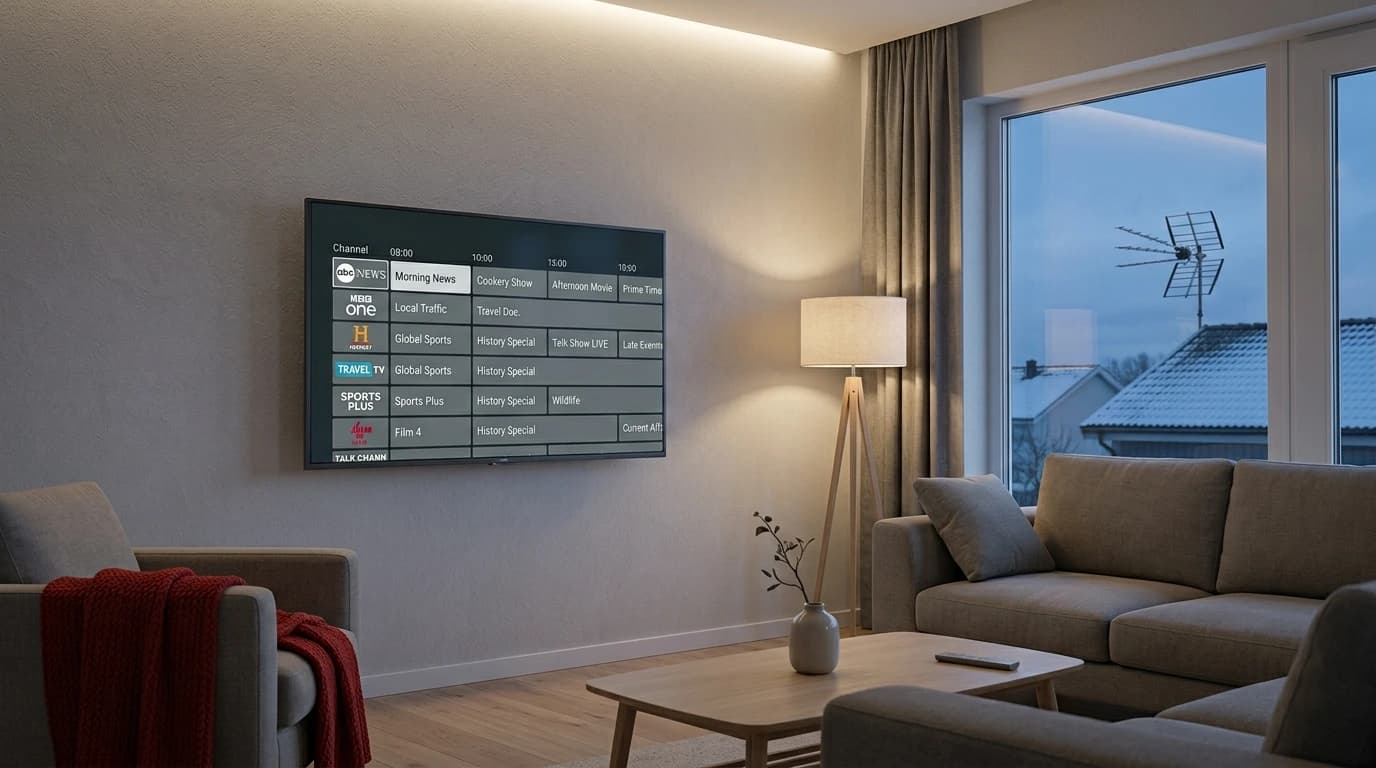
Digital TV in Sweden explained: the four ways TV reaches a home, the new 2026–2033 licence period, the shrinking aerial network and what changes in 2027.
Digital TV in Sweden looks different this autumn than it did two years ago. A new public service licence period began on 1 January 2026, commercial channels have left the aerial network, one channel disappears entirely at the next new year, and a government inquiry is currently reviewing how radio and TV should be distributed at all.
If you have recently moved here, this is also the guide nobody hands you: how television actually reaches a Swedish home, what you need, and what you can ignore. Information checked 6 October 2026.
What this guide covers
Digital TV means picture and sound sent as data rather than as an analogue signal. Sweden switched off its analogue terrestrial network back in 2007, so every television you watch here is digital. The only question is which route it takes to reach you.
Four routes run in parallel:
| Route | What it needs | Typical for |
|---|---|---|
| Terrestrial network | an aerial and a compatible receiver | houses and older buildings, areas without fibre |
| Cable | a cable connection in the building | apartment blocks with a collective contract |
| Satellite | a dish and a receiver | countryside, summer houses |
| Internet | broadband plus an app or a box | a growing majority, whatever the housing |
The same channel can reach you by several of these at once. That is why "do I have digital TV?" is almost always answered yes — and why the useful question is which route carries your viewing, and what happens when that route changes.
One warning about the words. In everyday Swedish, digital-tv often still means terrestrial TV through an aerial, because that is where digitisation was first visible. Operators use the same phrase for their channel packages regardless of technology. Official inquiries instead distinguish by distribution method. Same term, three meanings — worth knowing when comparing offers.
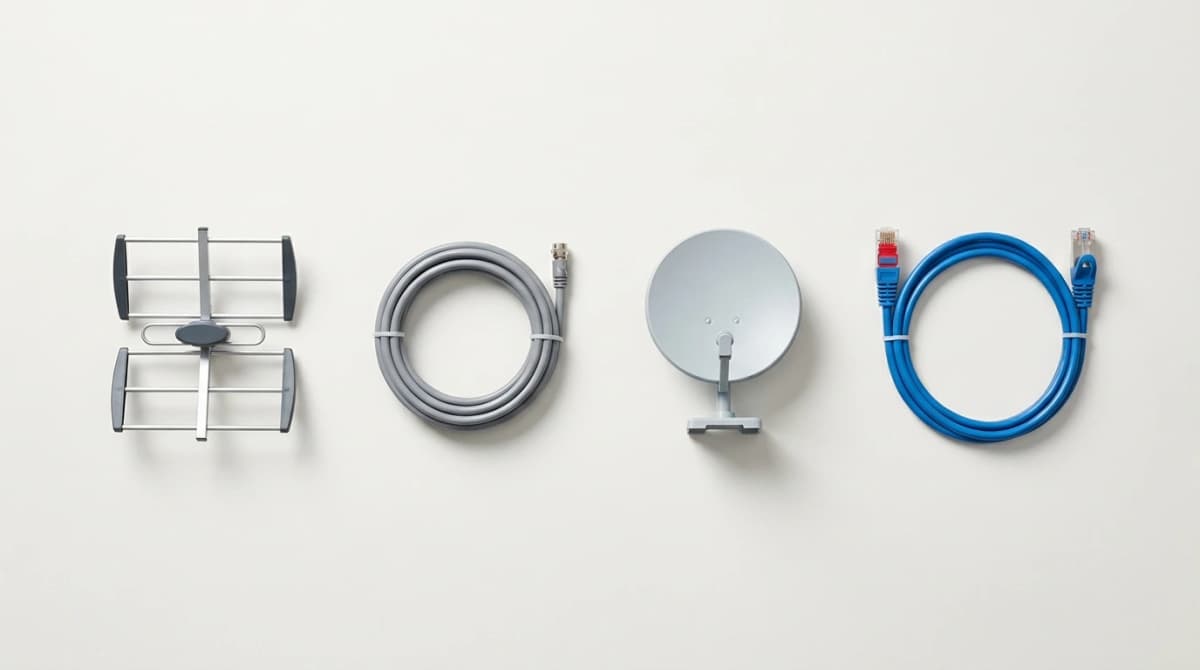
The choice is rarely about taste. Three things settle which form of digital TV makes sense for a household here, and none of them is brand loyalty.
Where you live. If fibre is installed, the internet route is almost always simplest. Without fibre, and with weak mobile coverage, the aerial is still the most robust option.
What the building already has. In apartment blocks the question is often decided for you: a collective contract provides a basic line-up included in the monthly fee, whether or not you use it.
How you watch. Someone who mainly follows the news and a few fixed programmes is well served by a small line-up. Someone following series, sport and film across several services has a completely different need, and flexibility matters more than channel count.
One mistake worth avoiding: adding a new solution on top of an old one without removing anything. That is how a TV bill grows without anyone deciding it should.
Today's digital TV landscape makes more sense with the history behind it, because the pattern repeats: the technology changes, the line-up moves, households replace equipment. The timeline below runs from the digital terrestrial launch in 1999 to today, where television has effectively moved into the broadband connection.
| Year | What happened |
|---|---|
| 1999 | Digital terrestrial TV introduced in Sweden |
| 2005–2007 | The analogue network switched off, region by region |
| 2010 | HD broadcasts begin in the terrestrial network |
| 2016–2017 | Migration to DVB-T2 as the 700 MHz band is cleared |
| 2025 | Pay TV leaves the terrestrial network |
| 2026 | TV4 stops free-to-air there; the new licence period begins |
| 2027 | Kunskapskanalen ends as a linear channel |
The analogue switch-off began on 19 September 2005 and ran in geographic stages until 29 October 2007, according to the overview of Swedish digital terrestrial television (in Swedish). HD broadcasts arrived in November 2010, and the move to the newer DVB-T2 transmission standard happened gradually between March 2016 and December 2017.
Two forces drive it. Spectrum: mobile broadband and terrestrial TV compete for the same airwaves, so when a band moves to the mobile networks, broadcasts must be packed more efficiently — exactly what happened when 700 MHz was cleared. And compression: newer technology fits more channels into the same space, with households paying for a newer receiver at irregular intervals.
For anyone watching digital TV today the lesson is simple: terrestrial equipment has a limited lifespan, while an app in a smart TV updates itself. That is one of the real differences between the routes in the table above.
This is the biggest regulatory change in eight years. On 4 December 2025 the government set the broadcasting licences and public service remits for Sveriges Radio, SVT and UR covering 2026–2033. The remit is now technology-neutral, and SVT must still broadcast terrestrially.
On 4 December 2025 the government set the broadcasting licences and public service remits for Sveriges Radio, SVT and UR covering 2026–2033. Much of the remit became technology-neutral: programme activities are covered by the same conditions however the content reaches the audience, according to the government's press release (in Swedish).
Three parts matter:
That last point explains much of what follows: tighter funding is exactly what SVT and UR point to below.
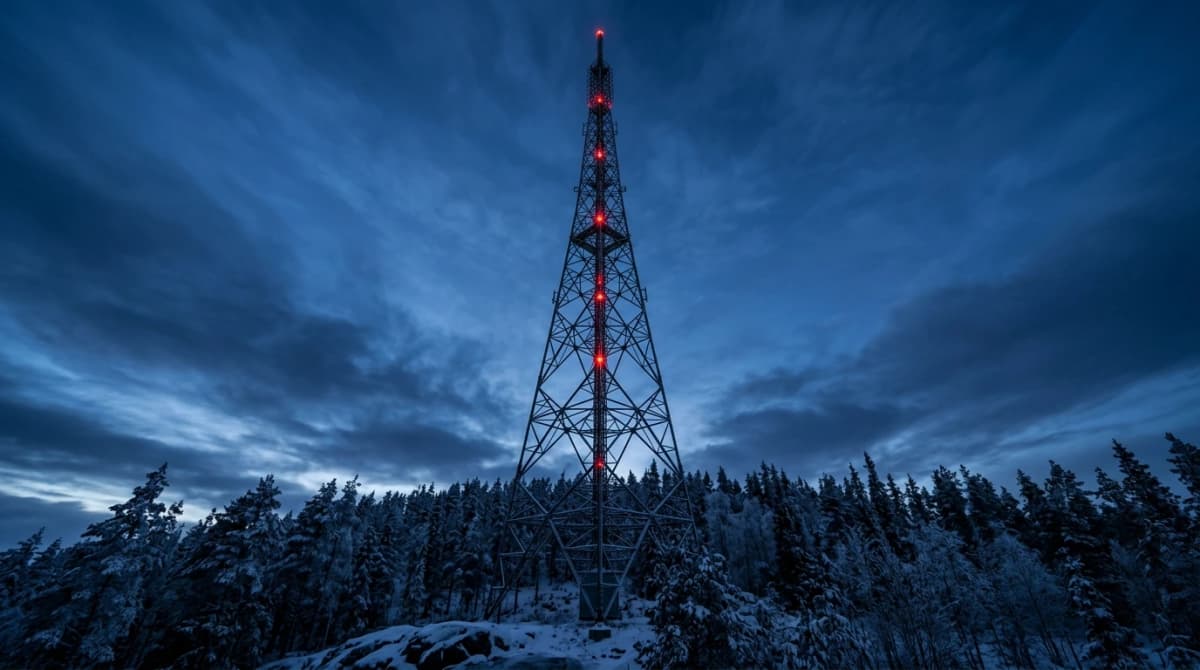
The phrase sounds bureaucratic; the consequence is concrete.
The remit used to be framed largely around broadcasts. A programme counted when it aired on a channel. Now the same programme counts equally when published in a play service, and the content requirements follow it whichever route it takes.
For a viewer that means three things. Public service can prioritise where the audience is without being penalised when a channel loses viewers. Closing linear channels becomes easier to justify — Kunskapskanalen is the first clear example. And the terrestrial obligation still stands, so the change does not make the aerial pointless. It both enables and restrains: a faster move online, with the terrestrial floor fixed to 2033.
The terrestrial network has changed most, and the picture cuts both ways: coverage is close to complete at about 99.8 percent of the population, while ever fewer households actually use it. A network with almost total reach and a shrinking audience is exactly the tension now under review.
Coverage is close to complete. The inquiry into radio and TV distribution records about 99.8 percent population coverage and describes the network as robust in a crisis, in its report SOU 2025:116 (in Swedish). That argument carries weight in emergency planning: an aerial works when the internet does not.
Use, however, is falling. The same inquiry describes a clear trend of declining terrestrial viewing, and notes that relatively few households still own the equipment required. The line-up has thinned too: pay TV left the terrestrial network in January 2025 and TV4 stopped broadcasting there as free-to-air in January 2026. We covered what that meant in our guide to IPTV across the Nordics.
The result is a network with almost complete reach and ever fewer people using it — precisely the tension now under review.
The terrestrial network is not one broadcast but several parallel networks, called multiplexes or MUX. Each carries a bundle of channels, and coverage differs between them. The first five networks cover 99.8 percent of the population, while MUX 6 reaches about 90 percent and MUX 7 about 30 percent, according to the same overview.
That explains a common confusion about terrestrial digital TV: two households in the same municipality can receive different numbers of channels, with nothing wrong with either setup. One is within reach of more transmission networks.
It also explains why a channel rescan is sometimes needed. When content moves between networks, the old channel list stays in the TV until you scan again. A television that has "lost" channels usually isn't broken — it is looking in the wrong place.
The next concrete change has a date. Kunskapskanalen stops being a linear channel on 1 January 2027. Its programming moves to UR Play, SVT Play and to SVT2 at fixed times Monday to Thursday, 16:00–19:00 and 20:00–21:00, according to SVT (in Swedish).
SVT and UR cite changed viewing habits and ongoing savings. For a viewer it means:
It is also a clear signal of direction: themed channels are wound down, and their content moves into the play services and the main channels.
A channel closing does not mean the programmes disappear, and the distinction is worth being clear about.
The programmes continue, but you find them differently: you look them up in a play service, or watch on SVT2 during the hours set aside. For anyone who likes landing on a channel and staying there, that is a genuine loss. For anyone who already searches for programmes, it changes nothing.
The pattern is familiar across the Nordics and is fundamentally the same movement this guide describes: digital TV is moving from fixed channels to libraries, and the schedule becomes one way of finding something rather than the only way.
In 2024 the government commissioned an inquiry into how radio and TV are distributed through the terrestrial network and over the internet. A partial report arrived in December 2025, and supplementary directives added the question of whether the networks' organisation and financing need to change. The final report was due by 30 September 2026, according to the government (in Swedish).
It is led by Charlotte Ingvar-Nilsson, former director-general of what is now the Media Authority. Its conclusions will not change what you watch tonight, but they shape how long the aerial network survives in its present form and how internet distribution gets regulated.
There is no answer until the report is published and consulted on, but the questions suggest the range. The inquiry examines the terrestrial networks' organisation and financing, which means three possible directions:
Against a quick shutdown: a network reaching 99.8 percent that works when the internet is down is hard to replace in a crisis. For slimming it: cost per viewer rises every year as fewer people use it.
Whatever the outcome, the advice holds — don't build your setup on nothing changing, and avoid contracts that tie you in longer than you can see ahead.
The fastest-growing route deserves its own explanation, because it works unlike the other three. With terrestrial, cable and satellite every channel is sent to every receiver at once. Over the internet only the stream you asked for is sent, to your connection alone.
With terrestrial, cable and satellite, every channel is sent to every receiver at once and your box selects the one you watch. With digital TV over the internet, only the stream you choose is sent, to your connection alone. That is why the line-up is not limited by how many channels fit in a broadcast network, and why pause and restart feel natural in an app but are rare in an aerial broadcast.
In practice you meet two variants. Play services — SVT Play, TV4 Play and the international streamers — are individual apps with their own libraries. IP-based channel TV is a channel package played in a player app with a TV guide, much like a traditional channel list delivered over the network. Operator TV apps and standalone IPTV services both belong here.
The technical requirement is the same for both: a stable connection. Quality is decided by your network and the service, not by how far you live from a transmitter mast — the big practical difference from the aerial network.
The difference shows up most in how you find something to watch.
In a play service you start in a library. The content sits waiting, you search or browse, and the schedule is irrelevant. SVT Play works this way, as do the international streamers.
In a channel package over the internet you start in a schedule, exactly as in the terrestrial network. Channels broadcast to a timetable and the app shows what is on now and next. Many such services add features an aerial broadcast cannot offer: restarting a programme already under way, pausing live TV, or going back a few days.
Most households use both without thinking about it. The distinction matters only when dropping one: a play service rarely replaces a schedule, and a schedule rarely replaces a library.
Three things, in descending order:
For terrestrial digital TV you need three things: an aerial, a receiver that handles the transmission standard, and a completed channel scan.
The aerial can be on the roof, in a window or indoors. A roof aerial almost always performs best, and it should point at the nearest transmitter. The receiver is built into most televisions sold in recent years; an older set may need a separate box.
The channel scan is the step most often forgotten. Redo it whenever the line-up changes: most recently when TV4 left in January 2026, and next at the new year when Kunskapskanalen closes.
Here the requirements differ. No aerial is needed, but the connection must be stable. Choosing between the options, and checking your connection can carry them, is covered in our guide to internet TV.
| Symptom | Most likely cause | What to do |
|---|---|---|
| Channels missing via aerial | the line-up changed | run the channel scan again |
| Blocky or frozen picture via aerial | weak signal, wrong direction, poor cable | check the aerial and connectors |
| Stuttering over the internet | Wi-Fi or a congested home network | connect an Ethernet cable |
| Everything works except one service | a problem at the service | check its status page |
| Sound but no picture | wrong HDMI input or cable | change input and cable |
Troubleshooting differs by route — another reason to know which one your digital TV takes.
The answer depends on how you watch today. If you watch through an aerial you are most affected; if you have cable or fibre through the building the terrestrial changes pass you by; and if you mostly use play services you will barely notice. The four cases below cover most households.
For newcomers, the shortest honest answer is that a broadband connection plus the apps you want covers almost every need, and that SVT Play is already funded by the public service fee you pay through tax once you work here.
Two practical notes that save money. First, check the building before buying: in many Swedish apartment blocks a digital TV package is bundled into the monthly fee, and paying separately for the same channels is the most common waste. Second, if your stay here is open-ended, prefer arrangements you can end quickly — digital TV over the internet is easy to stop, while an operator contract with a binding period is not.
The house without fibre. The terrestrial network still matters here, sometimes as the only option for linear TV. Check the aerial and rescan at the new year. Mobile broadband can supplement play services, but check coverage and data limits first.
The flat with a collective contract. A TV package is probably already in the monthly fee, and paying twice for the same channels is common. Ask the housing association or landlord what is included before adding anything.
The newcomer. For most arrivals, digital TV means broadband plus the apps you want, and that is almost always enough. An aerial is rarely worth the trouble in a rented flat, and SVT Play is already funded by the public service fee you pay through tax once you work here. More on that fee is in our breakdown of TV costs in the Nordics.
Five things that take fifteen minutes, whichever form of digital TV you use, and save irritation in January.
None requires switching anything. They just mean you know what you have — the precondition for choosing something else.
Digital TV runs on abbreviations, and they turn up in everything from operator offers to licensing decisions. The table below collects the terms that recur in this guide — marknät, DVB-T2, MPEG, EPG, IPTV, OTT and a few more — each explained in a single line.
| Term | What it means |
|---|---|
| Marknät | the terrestrial transmission network for TV via aerial, operated by Teracom |
| MUX | a multiplex, meaning one transmission network carrying several channels |
| DVB-T / DVB-T2 | the two generations of transmission standard for terrestrial digital TV |
| EPG | electronic programme guide, the schedule in your TV or app |
| Catch-up | the ability to watch programmes afterwards, often a few days back |
| Play service | an app with a library of programmes and no fixed schedule |
| IPTV | television delivered over internet protocol, often as a channel package with a schedule |
| OTT | "over the top", television travelling across the open internet rather than an operator's own network |
| Linear TV | channels broadcasting to a schedule, as opposed to on-demand |
| Public service-avgift | the fee funding SVT, SR and UR, collected through tax |
Two of these get confused. IPTV describes the technology and applies equally to an operator's own TV network and to a standalone service. OTT means the traffic crosses ordinary internet without special treatment. A service can be both at once, which is why neither word tells you anything about quality.
IPTV NORDIC is one of the routes in the table above: television over the internet, with login credentials that work in standard IPTV apps on smart TVs, Android TV, Fire TV Stick, Apple TV, phones, tablets and computers. We do not broadcast in the terrestrial network and we sell no hardware.
According to our service description it includes 18,000+ live channels, 40,000+ movies and 12,000+ series, 8K / 4K Ultra HD ready with FHD where available, a TV guide (EPG) and catch-up, activation in about a minute, round-the-clock support and a seven-day money-back guarantee. Plans cost €15 for one month, €35 for three, €45 for six and €65 for twelve months, with 2–5 simultaneous streams depending on the plan. There is no binding period and nothing renews automatically. See every feature, the supported devices, or start from the home page.
What we don't claim: that any specific named channel or sport is included, that we replace public service, or that we sell any way around geographic restrictions. How to vet any provider, including us, is in our guide to the company behind a service. Questions before buying are answered in the FAQ or through the contact page.
Digital TV in Sweden travels four routes, and for more households every year the internet is the one carrying the viewing.
The rules are new since 1 January 2026. The 2026–2033 licence period is technology-neutral, SR and SVT must still broadcast 2–4 channels through the aerial, and funding grows more slowly than before.
The aerial network has near-total coverage but shrinking use — 99.8 percent of the population, fewer channels, fewer viewers. That tension is what the current inquiry exists to resolve.
Kunskapskanalen ends as a linear channel on 1 January 2027, moving to SVT2, SVT Play and UR Play.
To compare internet TV against what you have now, every plan and condition is on the plans and prices page.
Choosing internet TV in Sweden? 98% can get gigabit broadband but only 61% subscribe. How to check your connection first, then pick the right service.
What IPTV bolaget means, what Swedish law actually says in autumn 2026, and how to check the company behind a service before you pay for it.

Best and cheapest IPTV are two different questions. How Sweden's 30-day price rule works, and the change that may remove it for subscriptions.